Tuesday, January 21, 2014

Sarah and Edgar at the Athenaeum

Providence Athenaeum, Benefit St.
The Providence Athenaeum.
One of the most beautiful early 19th century buildings in Providence is the Athenaeum, a membership library built in 1838 in the Greek Revival Style.

It was within its dark and comforting confines that Sarah Helen Whitman, a Providence poet and essayist, found solace from her difficult home life, and was able to write and think in peace.
Sarah Helen Whitman House, Benefit St., Providence RI
Sarah Helen Whitman House, 88 Benefit Street.


Sarah Helen Power was born in 1803, and lived in a house at 88 Benefit Street, less than a half mile from what was to become the site of the Athenaeum.

She married a young Brown University graduate, John Winslow Whitman, and went to Boston to live with him in 1828. There she developed friendships with the leading literary lights of the time and place--Ralph Waldo Emerson, Henry David Thoreau, and Henry Wadsworth Longfellow among others.

Sadly, John died in 1833, and Sarah returned to Providence to live with her unhappy mother and mentally ill sister. The construction of the Athenaeum five years later must have seemed like a godsend.

Portrait of Sarah Helen Whitman by C. G. Thompson, 1838.
Portrait of Whitman by C. G. Thompson, 1838.
By all accounts, Sarah was beautiful, witty, and warm, as well as liberal and unconventional. She liked to dress in what was considered a pagan style of dress--loose, white, filmy clothing with soft slippers and lots of scarves--her friends reported that as she strode down the street pieces of her costume would fly off, which they were forever picking up! She wore a tiny coffin on a chain around her neck.

She believed in transcendentalism, spiritualism, abolitionism, and feminism. She was widely read and fluent in four languages. She was a talented poet, an insightful art/literature critic, and a perceptive commentator on the contemporary scene. She belonged to various literary groups, and ran a popular poetry salon. She also mentored young writers at Brown.

Daguerrotype of Edgar Allan Poe, Providence, RI, 1848.
Daguerrotype of Poe from 1848.
By 1848, she was considered the best woman poet in America and she and Edgar Allan Poe (who was six years her junior) had come to each other's attention, and admired each other from afar. By this time, Poe was the rockstar of the American literary world. He was handsome and gifted, and had the manners of a southern gentleman.

They engaged in a passionate correspon-dence, and wrote poems dedicated to each other. Poe came to Providence to court her in person in September 1848.

He stayed at a hotel called the Mansion House on Benefit Street, a couple of blocks from her house, but of course she couldn’t visit him there. And her mother did not approve of Poe, so that ruled out meetings at her home. So they met at the Athenaeum and at the Swan Point Cemetery.

At one point she showed him an anonymous poem she admired in a book that was in the Athenaeum's collection—he told here he’d written it, and signed that page in the book—and that book with that signature is still there. (Apparently it's OK to deface library books, if you're Edgar Allan Poe!)

After a brief courtship, Poe pressed her to marry him and she demurred--her health, her age, her mother's disapproval of his drug and alcohol habits. He promised to give up drinking if she would agree to marry him (a promise frequently made and frequently broken throughout history), and so she did.

This prompted New York Tribune editor Horace Greeley to write to a fellow editor:
Do you know Sarah Helen Whitman? Of course, you have heard it rumored that she is to marry Poe. Well, she has seemed to me a good girl, and--you know what Poe is . . . Has Mrs. Whitman no friend within your knowledge that can faithfully explain Poe to her?
The wedding was due to take place on December 25th, and on December 23rd Sarah and Edgar were in the Athenaeum with some other people when someone handed her a note (so junior high!). They had seen Edgar drinking the previous night and that morning.

Sarah called off the wedding, fled down the street to her house, breathed a little ether (her drug of choice), and was swooning on the sofa when Edgar caught up with her.

They never saw each other again, and he would be dead within 10 months.

But Sarah would live for another 30 years, publishing her poetry and essays and fostering generations of younger writers and artists.  More than 80 of her essays were carried in the pages of the Providence Daily Journal as letters to the editor, book reviews, travel correspondence, and general essays.  She was active in the woman suffrage movement, and served as VP of the state suffrage association when it was formed in 1868.

However, despite all these accomplishments, she is most remembered today as a defender of Poe against his critics.  She published a scholarly brochure entitled Edgar Poe and His Critics in 1860—it’s the only work of hers that’s still in print.  She was almost singlehandedly responsible for saving Poe’s reputation which had been savaged by critics and editors after his death.


Illustration Credits and References

Photo of the Athenaeum from their website.

Photo of Sarah Helen Whitman house by the author.

Painting of Sarah Helen Whitman from the Brown University Portrait Collection.

Daguerrotype of Poe from the eapoe.org website.

Information for this post came from a number of sources including the Providence Athenaeum website, a book by Brett Rutherford, Last Flowers: The Romance and Poetry of Edgar Allan Poe and Sarah Helen Whitman, Poet's Press, 2011, and a lecture given by Sarah O'Dowd on May 2, 2012 at the Community Church of Providence.

Horace Greeley quote from the January 21 entry in A Reader's Book of Days, edited by Tom Nissley, W. W. Norton & Company, New York, 2014. Greeley wrote the letter on January 21, 1849, apparently not aware that the engagement had been broken a few weeks before.

Friday, December 6, 2013

Gorham Silver, Part 7: It's a Wrap

As mentioned in Part 6 of this series, Gorham reached its zenith of accomplishment in the years when Edward Holbrook served as president and William C. Codman as chief designer.  Codman retired in 1914, and Holbrook died in 1919, bringing this Golden Age to a conclusion.

Interestingly enough, both of their sons took over their roles--John Holbrook as president and William Codman as chief designer.  John had been a VP for 13 years when his father died, but he was a disaster as president, and the company went through five presidents between 1919-1923 before Edmund Mayo took over the reins.

William Codman was well-trained in academic styles, but was not a fan of "modern" design, which was being demanded by the public. Codman's opinion of modern design an be summed up in his 1929 book on the History of Silverware Design:
Recently, a style so called "Modern" has been introduced to the public, but it does not appear to have made much headway. . . . If we see elements of the Greek, the Gothic, or more of the Italian Renaissance in our silverware, let us be thankful our designers have the good sense to value the best in the past.
Codman stayed on at Gorham as chief designer into the 1930s, but Mayo took some steps to reduce his influence. One of the things he did was to bring in Erik Magnussen, a Danish modernist silversmith, who worked as a designer at Gorham, independent of Codman, from 1925-1929. His official title was "Designer (Special Work)".

Erik Magnusson coffee service, 1929; in the RISD Museum.
Erik Magnusson coffee service, 1929.
Here is a beautiful coffee service called "Cubic," designed by Magnusson in the style of Cubist painting, and meant to evoke skyscrapers, radio, motorcars, and jazz. The form consists of a series of irregular triangles, and flat, shiny silver areas contrast with triangles of gilt and oxidized brown.

This set was radical, even for Magnusson. It was exhibited a number of times, and was pictured in the New York Times where it was named "The Lights and Shadows of Manhattan." It is currently on permanent display at the RISD Museum.

When the depression hit, production slowed significantly, though Gorham kept their artisans working--they meticulously produced hundreds of examples of 19th century hollowware from original designs and dies. Today these pieces are the only known examples of certain Gorham patterns.

After the attack on Pearl Harbor, the company stopped making bronze and brass goods, all plated wares, and most church goods. Hollowware production was cut by 70%, and sterling flatware was limited to six-piece place settings in 13 patterns.

More than 30 kinds of war materiel were manufactured at the Gorham plant during the war, including millions of 40mm shell casings, small arms parts, tank bearings, and torpedo components.

In the 1950s and 1960s, Gorham embarked on an acquisition program to expand their lines and diversify. They acquired silver and bronze companies, as well as companies in other industries. By the middle 1960s they were cash rich, with 2,400 employees and $40 million in sales. They were a prime candidate for a takeover, so in 1967 they merged with Providence company Textron, whom they'd approached as a "safe haven."

By 1985, due to a variety of causes such as rising silver prices and reduced demand, and possibly a lack of focus due to their wide product lines, Gorham had shrunk significantly in size. Textron therefore relocated manufacturing from the Providence plant to a Smithfield, RI facility, where it remained until 1992, when it moved out of state.

Textron sold Gorham in 1988. Since 2007, the sterling silver patterns have been made by Lifetime Brands, who also own the Wallace and Towle Silversmiths names. They still produce 19 patterns of flatware, including Chantilly, which has been made continually since 1885! Gorham stainless steel flatware is manufactured by Lenox Brands.

The site on which the Gorham plant stood was acquired by the City of Providence in 1990. Serious concerns were raised about the site's environmental safety, and it was named a "superfund" brownfields site in 1995.

Providence was unable to interest developers in the Gorham plant buildings, so all (except the Carriage House) were demolished in 1997. The City built Alvarez High School on part of this site; it opened in 2008.
Location of Alvarez High School, on former site of Gorham plant.
The last remaining building, the Carriage House, was being restored by local firefighters to become the Providence Fire Museum, but was destroyed by a fire "of suspicious origin" in 2009, bringing to a sad end the long and colorful history of Gorham Silver in Rhode Island.

Illustration Credits and References

Photo of Magnusson coffee service by the author.

Providence Journal, "Fire destroys carriage house that was to become fire museum," by Maria Armental, April 15, 2009.

An exhaustive history of Gorham can be found in the book Gorham Silver by Charles H. Carpenter, Jr. (Revised edition published 1997 by Alan Wofsy Fine Arts, San Francisco.)

Gorham Silver, Part 6: The New Plant and the Apogee of Accomplishment

The rise of Edward Holbrook discussed in Part 4, and the creation of the bronze business discussed in Part 5, coincided with a need for expansion, since Gorham had filled the Steeple Street block to capacity. Holbrook had not yet taken on the presidency of Gorham, but he certainly heavily influenced the 1888 board decision to build a brand new plant on a multi-acre site off Adelaide Avenue in the Elmwood section of Providence.

Architect's drawing for Gorham Manufacturing plant, about 1890.
Architect's drawing of the new Gorham plant, about 1890.
When the plant opened in 1890, it was the most modern in the world for making silver and bronze. It consisted of 33 acres and 25 buildings, and had its own water supply (Mashapaug Pond, the largest body of fresh water in the city). It also had its own fire department, electric light plant, and photo studio, and a building for making the wood cases for the silver. It also included a library and a museum, and a dining room and recreation center for the workers (which was very forward-thinking at the time!)

After the move, Gorham hired a new chief designer, William C. Codman, a 52-year-old Englishman. Codman was the chief designer for the pieces Gorham made for the Columbian Exposition in Chicago in 1893, where Gorham won 55 medals! He also designed the Chantilly flatware pattern in 1895, which has always been Gorham's best seller. Codman would go on to design over 50 flatware patterns during his 23 years at Gorham, but this was clearly the winner and is still made today. It was the most popular sterling flatware pattern made in the 20th century, by any company.

Lady's writing table and chair, Gorham Silver, 1903; at RISD Museum.
Lady's writing table and chair, Gorham, 1903.
In 1894, Holbrook officially took over the reins of the company; the years from the completion of he new plant to 1914, when Codman retired, are considered to be some of the greatest of Gorham's achievement. Holbrook and Codman had a great partnership and vision; Burr Sebring, who was the director of design at Gorham in the 1970s, called it a "perfect matrix of leadership and artistry."

Among the many beautiful pieces designed by Codman was a lady's writing table and chair made in 1903 to exhibit at the 1904 Worlds Fair in St. Louis. (That was the "Meet Me in St. Louis, Louie" fair.) There was also a 16-piece silver desk set that went with it.

It's a real tour de force and was intended to showcase the incredible talent of the Gorham artisans. Click here to examine the desk in more detail.

William Codman signature on lady's writing table, Gorham Silver, 1903.
William Codman signed the piece.
It was designed by Codman, but the work was executed by many, many craftsmen. There were silversmiths, chasers, modelers, inlayers, leather carvers, and cabinetmakers. However, Codman, as the chief designer, got to sign the piece in the right top drawer.

The desk is particularly remarkable in its use of silver, ivory, and mother of pearl inlay in the challenging surface of ebony and rosewood.  The form of the desk is 18th century French rococo, the women on the drawers and legs very Art Nouveau, and the arabesques on the top are traditional Hispano-Moorish.
Costing slip for Gorham Silver lady' writing desk, 1903.
Costing slip for the desk.

The back border on the top includes morning glories for morning and poppies for evening, as well as an owl to represent wisdom, and perhaps inspire the writer?

There are about 50 pounds of silver in the desk and chair, and over 12,000 hours went into the creation of this work. The cost was almost $13,000; the costing slip for the desk alone is shown here. The price was set by Gorham at $18,000 for the desk and chair, plus another $2,000 for the desk set.

The pieces were awarded the Grand Prix for silversmithing in St. Louis, and they were also exhibited at the Panama-Pacific International Exposition in San Francisco, where they won the gold medal.

Antoinette Heckscher, Lady Esher, who owned the Gorham lady's writing desk.
Lady Esher and daughter, 1932.
Sometime after that, the set was purchased on behalf of a young American socialite, Antoinette Heckscher, who had married the British Viscount Esher, and had become Lady Esher in 1912. Antoinette had gotten a lot of society attention for announcing her engagement in the New York Times on 11/11/11, breaking it in January (also in the paper), and then remaking it, to marry later in 1912. The Times said of her that she was "highly cultivated, had traveled much, and is interested in the woman suffrage movement. She marched last May in the big suffrage parade."

Antoinette died in 1965, but had unloaded the desk and chair prior to that, since the pieces turned up at a Christie's auction in London in 1954. It was purchased for $3,500 by Mr. & Mrs. Frederick Thurber of Providence, descendants of Gorham Thurber, a former business partner of John Gorham, and they donated it to the RISD Museum--bringing it full circle back to its place of origin.

(to be continued)

Illustration Credits and References

Photo of the writing table from the RISD Museum website.

Photo of the signature and the costing slip from the Brown Digital Repository.

Photo of Lady Esher from ancestry.com.

New York Times, "Miss Hecksher to wed O.S.B. Brett," August 29, 1912.

Architect's drawing of the new Gorham plant, plus an exhaustive history of Gorham can be found in the book Gorham Silver by Charles H. Carpenter, Jr. (Revised edition published 1997 by Alan Wofsy Fine Arts, San Francisco.)

Gorham Silver, Part 5: The Bronzes

George Washington bronze at U.S. Capitol Rotunda; manufactured in 1909 by Gorham Silver.
George Washington bronze, 1909.
Gorham had started making small bronze pieces in 1860, and in the 1880s they opened an ecclesiastical department, making silver chalices, patens, cups, and crosses for churches. It was a logical next step to make bronze items for churches--lecterns, altar rails, doors, crucifixes, and sculptures.

In 1885, they made their first large non-ecclesiastical bronze sculpture for a Civil War memorial at Gettysburg, a statue called The Skirmisher. The sculptor, Frederick Kohlhagen, had approached Gorham to see if they were interested in casting it. Prior to that point, most large scale bronze casting had been done in Europe, but Gorham's completion of the project was the beginning of a hugely successful large scale bronze casting business.

Today there are over 700 Gorham bronze items listed in the Smithsonian Archives inventory of American sculpture. One of the best-known pieces is a 1909 bronze of George Washington that has a place of honor in the U.S. Capitol Rotunda.

Independent Man atop the RI State House; cast by Gorham Silver in 1899.
The Independent Man, 1899.
There are many Gorham bronzes in New England, included the Shaw Memorial by St.-Gaudens opposite the Boston Statehouse, the Gloucester MA Fisherman, the Brown Bear "Bruno" on the Brown University Quad, the Carrie Brown Bajnotti memorial fountain in Burnside Park in Providence, the Independent Man atop the Rhode Island Statehouse, and half a dozen statues at Roger Williams Park in Providence.

Some of the finest work done by Gorham in bronze were the doors, railings, etc. that enhanced many American public buildings in the first years of the 20th century. In Providence, the company carried out bronze commissions at the Union Trust Building, the First Baptist Church, the Fleet Library at RISD, the Mathewson Street Methodist Church, and the Old Stone Bank.

The Old Stone Bank had started out as the Providence Institution for Savings, but earned its moniker after its flagship stone building was constructed in 1854. In 1896-1898 a major expansion was done on the bank, doubling its size and adding an impressive dome.

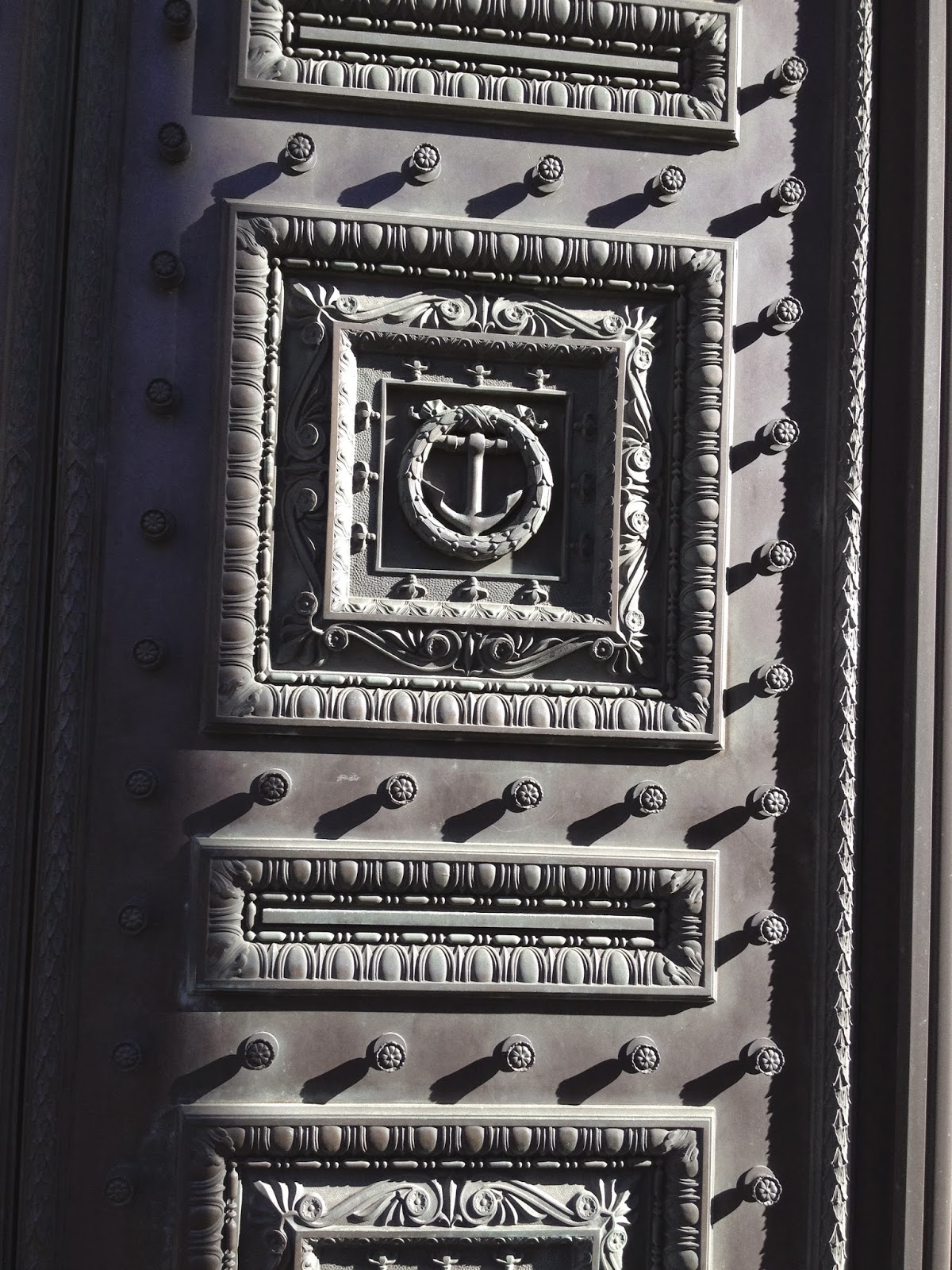
Old Stone Bank door, Providence RI; cast by Gorham Silver 1898.
Closeup of Old Stone door with RI anchor, 1898.
As part of this project, beautiful bronze doors by Gorham were installed. They weighed over 1,000 pounds apiece, and, according to a Providence Journal article from the opening 1898, are "so easily poised that they swing on their ball bearing pintles and hinges as easily as an ordinary house door made of wood."

The doors would stay open during banking hours, and entrance to the bank was through a marble vestibule with mahogany doors.

Besides its new dome and new doors, the bank was also equipped with the latest technology. The same Providence Journal article states: "The bank is equipped with a telephone closet with its long distance telephone, and also has an internal system by which the Treasurer, sitting at his desk, can talk not only through the telephone exchange to persons outside, but also to clerks within the bank and to the Providence National Bank."

(to be continued)

Illustration Credits and References

Photo of George Washington bronze by CharmaineZoe found on FlickRiver.

Photo of Independent Man by Trent Maynard, found on the State Capitols website.

Photo of Old Stone Bank door by the author.

Providence Sunday Journal, March 6, 1898.

An exhaustive history of Gorham can be found in the book Gorham Silver by Charles H. Carpenter, Jr. (Revised edition published 1997 by Alan Wofsy Fine Arts, San Francisco.)