Saturday, November 23, 2013

Gorham Silver, Part 2: The Strategist

Gorham and Webster had generated a lot of business since its formation in 1831 and by late 1840/early 1841 the 49-year-old Jabez Gorham was comfortably well-off and ready to take an early retirement. The firm was split into two--a silver company and a jewelry company. Jabez's former partner, Henry Webster, acquired the silver half under the name H.L. Webster & Co., and the jewelry business was taken over by the partnership of Church & Metcalf.

But the retirement was short-lived. Later in 1841 Henry Webster was made a Boston offer he couldn't refuse, and he wanted to sell his Providence business. Jabez agreed to buy it back only if his son would go into business with him.

Photo of John Gorham, ca. 1865.
John Gorham ca. 1865.
John Gorham was the third child of Jabez and Amey Gorham, and his mother had died shortly after his birth. He was not quite 21 when he agreed to go into business with his father. (He'd spent the previous few years working on a farm and as a retail clerk.) He did not know much about the silver business, but he was ready to take on the challenge, and it turned out that he was eminently suited to it.

J. Gorham & Son prospered during the 1840s, and by 1847 they had outgrown their space at 12 Steeple St.  There they occupied the first floor, the basement, and half the attic, while Church & Metcalf (who'd acquired the jewelry business in 1841) worked on the second floor. Power when needed was provided by a horse-driven shaft in the basement; when they wanted extra horsepower on the first floor, they called through a speaking tube to the basement: "Get up, Dick!" They needed a steam engine but the building wasn't big enough to support it.

So John suggested they buy the lot next door, and build a four-story brick building, equipped with a 50-horsepower steam engine, to house manufacturing.

By 1848, Jabez had become nervous about the debt burden they were undertaking for the expansion, and so John (at the age of 28) bought him out, and became sole owner of the company, and Jabez retired for the second time.

The new building was completed in 1849, and by 1850 John was running a company with 14 employees that had nearly tripled its sales (to $30,000) since 1841.

But John did not want to rest on his laurels--he had a plan for expanding the company and four strategies for achieving his expansion goals. These strategies would seem obvious today, but in 1850 they were revolutionary:
  • Make all kinds of silver wares, not just spoons
  • Make only the best wares in the latest fashions
  • Mechanize operations
  • Hire a dedicated sales force and support it with a vigorous marketing campaign

(to be continued)

Illustration Credits and References

Photo of John Gorham from rootsweb, an ancestry.com community.

An exhaustive history of Gorham can be found in the book Gorham Silver by Charles H. Carpenter, Jr. (Revised edition published 1997 by Alan Wofsy Fine Arts, San Francisco.)

Friday, November 22, 2013

Gorham Silver, Part 1: The Entrepreneur

Seril Dodge House, Thomas St., Providence RI.
Seril Dodge House, Thomas St., Providence.
Gorham was a name I always knew. I picked out my silver pattern when I was 12; "Celeste" was a brand-new pattern that year, and I think I saw the ad for it in American Girl magazine. My folks would give me a few pieces in my stocking every year, and wedding gifts finished the set for me. (I'd never pick out this pattern today--it looks very Disney/early space adventure to me now!!)

My Mom's silver was Gorham too. The "Lyric" pattern was introduced in 1940, so it was still a new pattern when she was married during the war in 1944.

This all came rushing back to me during the past month while I researched the history of Gorham for a special walking tour I conducted (along with two other guides) last Saturday. It was cosponsored by the Rhode Island Historical Society and the Rhode Island School of Design (RISD) Museum, and we visited both locations plus a number of stops in between.

To tell the story of Gorham, we need to go back to 1784 when two men named Seril and Nehemiah Dodge moved from Connecticut to Providence. They were either half-brothers, or uncle and nephew, and they are credited with developing the process of electroplating--depositing a thin layer of gold or silver on copper. Keeping in mind that only the well-to-do could afford jewelry made of pure silver and gold, the Dodges were able to make jewelry that could be sold to a wider audience.

Seril built two houses on Thomas Street in Providence in the late 1780s and early 1790s; both are still standing and now part of the Providence Art Club. He returned to Connecticut in 1796, but Nehemiah stayed in Providence. He opened a shop on Main Street, and he advertised his business in 1798 as selling "gold necklaces, knobs and twists, gold rings, miniature cases, and fine jewelry."
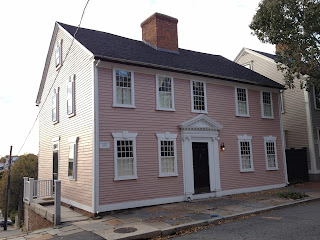
Jabez Goham House, Benefit St., Providence RI.
Jabez Gorham House, 56 Benefit Street, Providence.
Nehemiah lived at 65 Benefit Street, a few blocks from his shop. (The house is no longer there; a different house was moved to that location some years ago.) Across the street, at 56 Benefit, lived the Gorham family.

Jabez and Caty Gorham had eight children--their fifth child, born in 1792, was called Jabez like his father, grandfather, and great-great-grandfather before him. When young Jabez was 10 years old, his father died. This must have created financial pressure on the family, and at 14 Jabez was indentured as an apprentice to his neighbor, Nehemiah Dodge, to learn jewelry making.
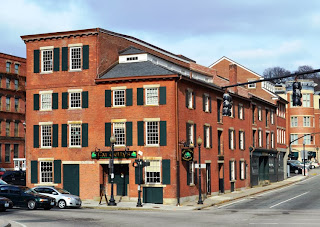
3 Steeple St., Providence RI.
3 Steeple Street, Providence.
In 1813, when Jabez completed the seven years of his apprenticeship, he opened a partnership with four other young men to make jewelry. Their firm (called "The Firm") was located in a building that no longer exists--the location is a parking lot at the corner of North Main and Steeple Streets. But the building must have looked much like the 1793 building that sits at the other end of Steeple Street (#3).

The Firm prospered for a few years, but hit a snag in 1818 and the partnership dissolved. However, Jabez Gorham stayed in business at the same location, operating under the name Jabez Gorham, Jeweler.

In the 1820s, with his business expanding, Jabez moved across the street to #12 Steeple. He was one of the first to manufacture what was called "French Filigree" jewelry, competing successfully with imported goods. He also designed a special kind of gold chain which became known as "The Gorham Chain." He sold goods from his shop on Steeple Street, and through peddlers--the manufacturer's reps of the day. He also traveled throughout New England and New York on sales trips himself. So he was a manufacturer, a retailer, a traveling salesman, and a sales manager--all at the same time!

Gorham coin silver spoon, ca. 1845.
In 1831, Jabez took on Henry Webster (a Boston silversmith) and the new Gorham & Webster operation started making coin silver spoons. These spoons had begun to replace pewter spoons in households throughout the eastern U.S. The spoons were very thin in order to keep costs down and make them affordable. (To give you a feeling for how thin, the average Gorham sterling spoon in the modern era weighs about two and a half times a coin silver spoon.)

1831 is considered to be the year that Gorham Silver was founded.

(to be continued)

Illustration Credits and References

Jabez Gorham house photo by the author.

3 Steeple Street photo from the Carlisle Wide Plank Floors website.

Gorham coin silver photo by Replacement Sterling 925 on eBay.

An exhaustive history of Gorham can be found in the book Gorham Silver by Charles H. Carpenter, Jr. (Revised edition published by Alan Wofsy Fine Arts, San Francisco, 1997.)


Tuesday, August 20, 2013

On Broadway, Postscript

Barnaby Carriage House
Barnaby Carriage House, 159 Sutton Street
On a walk this week down Sutton Street I came across this amazing structure in the middle of a street of frame houses. I jotted down the address and went exploring in my Providence volumes when I got home.

Barnaby Castle
Barnaby Castle, 299 Broadway
Turns out that this is the Barnaby Carriage House, built in 1875. It was originally part of the Barnaby Castle Estate at 299 Broadway, which was featured in my recent series on great Victorian houses on Broadway.  Part 2, A Castle and a Murder, describes the home, and the Colorado murder that helped to make it famous.

The carriage house is large and elaborate, and made of brick, unlike the home it accompanies which is wood frame. My reference book says it has a "Moorish-inspired facade" and that the top center part of the facade used to have a spire and a clock which have since been removed.

According to Zillow, it consists of a single-family residence of 3,480 sq. ft., with parking for six vehicles in the old carriage space. It was on the market for $799,000 for a year (serious wishful thinking!) but with no buyers it was taken off the market nearly two years ago.

You never know what you'll find in the neighborhood!

Illustration Credits and References

Photos by author.

Information about the property from the work Providence, A Citywide Survey of Historic Resources, by William McKenzie Woodward and Edward F. Sanderson, published by the RI Historical Preservation Commission in 1986.


Monday, August 12, 2013

Before Marriage Equality, This: The Union of Elizabeth Drexel and Harry Lehr


Boldini Portrait of Elizabeth Drexel Lehr
1905 portrait of Elizabeth Lehr. 
This 1905 portrait by Giovanni Boldini, which hangs at The Elms in Newport, RI, caught my eye yesterday and I wanted to know more about the beautiful woman in the glorious orange dress. She is Elizabeth "Bessie" Wharton Drexel, and her second husband was Henry Symes Lehr; this is their story.

Elizabeth was a well-to-do Manhattan socialite from the Drexel banking family. At 21, she had married John Vinton Dahlgren. Ten years later, John was dead and Elizabeth was left a young widow with a seven-year-old son. But one of her friends introduced her to the dashing Harry Lehr--an extremely popular (but distinctly unmoneyed) man about town. He was from "a good family" in Baltimore which had seen a reversal of fortune; like many young men and women of the time he saw his opportunity for redemption in marrying up. 

Lehr was handsome and fun, told a good story, and was a great friend of many women socialites in Manhattan and Newport (including Alva Vanderbilt Belmont, Caroline Astor, and Mamie Fish), who found him amusing. He helped them to choose their dresses, plan their parties, and lure their wayward husbands back. He loved to perform--telling jokes, playing the piano, and often dressing as a woman in various living tableaux.

Photograph of Harry Lehr
Harry Lehr.
He swept Bessie Drexel Dahlgren off her feet, and they married on June 1, 1901. The New York Times wedding announcement noted that Elizabeth was "sweetly gowned in white, instead of grey or heliotrope, the customary selection of widows." Harry was referred to as the "Beau Nash of today" and the "dictator of form and fashion and leader in the '400'."

After their wedding they traveled to a Baltimore hotel to spend the night. Bessie recalled later that she had arranged for a lovely wedding night supper to be set up in the dining room of their suite: "Caviar, quails in aspic, his favorite brand of champagne, the cabinet of cigars I had bought for him, along with the gold and enamel watch set beside his plate." But Harry sent word, via the servants, that he would dine in his room, and she would have to dine alone. Shortly thereafter he showed up to tell the horrified new bride in person that he did not intend to consummate the marriage, that he did not love her, and that he had only married her for her money. 

"I married you because the only person on earth I love is my mother. I want above everything else to keep her in comfort. Your father's fortune will enable me to do so. But there is a limit to sacrifice. I cannot condemn myself to the misery of playing the role of adoring lover for the rest of my life." Harry did promise to treat her well in public and to give her the freedom to do whatever she wanted.

Photograph of Elizabeth Drexel Lehr, dressed for presentation to Kaiser Wilhelm
Dressed for presentation to the Kaiser.
Today we would ask why Elizabeth Drexel Lehr did not simply exit the marriage. But she came from a Catholic family and Elizabeth's mother had actively banned from her company the few divorced women who traveled in her social circle. (The Drexels were so Catholic that Elizabeth's cousin, Katharine Drexel, became a Saint!) Elizabeth therefore felt she could not suggest divorce to her mother and had no one else in whom to confide. And of course she didn't know Harry's other secret, which would be obvious to anyone today: he was gay.

The story is so sad to me because both of these beautiful and talented people had to spend the next 28 years together in a loveless and unconsummated marriage, which lasted until Harry's death. His life prospects without a "good" marriage were probably bleaker than hers--to be poor and gay was not an attractive option. But life for her as a married woman (especially in a marriage with a man who did not wish to control her activities) would be much better than the one she would live as a rich widow (or as an ostracized divorcĂ©e). 

Both of them had outside relationships during the marriage, and after her mother's death Bessie came close to divorce when she fell in love with a man she identifies in her book as "Mr. X". But Mr. X died before she could proceed with the divorce.

Bessie and Harry lived in New York and summered in Newport during the early years of their marriage. They lived primarily in Paris after World War I, though Newport continued to beckon in the summer.

King Lehr and the Gilded Age, a book by Elizabeth Drexel LehrHarry Lehr died in 1929; after his death Bessie read his diaries which revealed his painful secret to her. In 1935 she authored a book about Harry and their life and times entitled "King Lehr" and the Gilded Age. (The quotes above from Bessie and Harry originated in this book, though they have been requoted in a number of other blogs, articles, and reviews.)

Seven years later she married the Irish Peer, Lord Decies. They were together only a few years; when Hitler invaded Paris, Baroness Decies fled to New York and Lord Decies stayed in Britain. They died four months apart in 1944. 

Friday, August 9, 2013

Marsden Perry's Skyscraper: The Union Trust Company Building

Union Trust Company Bank BuildingThis week's walk took me past The Union Trust Company Building at 60/62 Dorrance Street in Providence. This gorgeous edifice is a 12-story, steel-frame, brick and stone office building constructed in 1901-1902, and at the time it was the tallest in Providence, and possibly the tallest in New England!

It was built for the Union Trust Company, a bank helmed by Providence financier and industrialist, Marsden Perry, and it was built the same year that Perry bought, refurbished, and moved into the historic John Brown House at 52 Power Street. Stone, Carpenter & Willson, architects, were working on both projects, as well as on a renovation at 2 George Street, where Perry lived prior to moving into the John Brown House. Mr. Perry and his architects must have been very busy with construction details that year! (Not that the bank presidency was all Perry had to keep him busy--he also owned the Narragansett Electric Company and the city's trolley system.)

Banks were expected to be impressive buildings in those days--to instill in customers a feeling of confidence in the wealth and power of the bank and its management. And the Union Trust Company building certainly did that.

Union Trust Company Bank Building in 1906
The Union Trust building in 1906.
Industrial National Bank absorbed Union Trust in 1957 and the first floor continued to be used as a banking hall until 1978. The building was then acquired by Greater Providence Deposit and Trust Company in 1980, and used as their headquarters. Then came the Rhode Island banking and financial crisis of 1991, when the Governor closed 32 credit unions which were under-insured; this bank was one of the casualties.

The first floor became a restaurant called Federal Reserve in 1996, and has been occupied by The Dorrance restaurant since 2011.

Some of the interesting architectural and interior design features of this building include:

The Puritan and the Indian.
    The Puritan and the Indian sign
    Window at Union Trust Company Bank Building
  • a Corinthian-columned entrance with bas-relief figures of an Indian and a Puritan--carved by Daniel Chester French (who is more famous for the Lincoln Memorial in Washington DC and the Concord Minuteman). French appears to have been sought after by numerous local firms in the early 20th century; see my blog entry on French's beautiful elevator doors at another former bank not far from this one.
  • Banks of 20-foot high windows, each with a rosette in stained glass that contains the coat of arms of a major European banking family or center (all the big names of 1901). What reassurance this must have provided to the local bank customers--they could imagine their bank as practically on a first name basis with the Rothschilds, etc.
  • A 12-story staircase of green glass. At the time the bank was built, elevators had been invented, but none was able to handle a 12-story rise. The staircase was designed to let light pass through it from a skylight on the roof, and also was supposed to provide entertainment for those poor unfortunates who had to climb to the 12th floor!! Interestingly enough, Perry installed similar (though much smaller) glass staircases
    Glass Staircase Installed by Marsden Perry at Eliza Ward House
    The glass staircase at 2 George St.
    in the renovation of both his current home (2 George Street) and his future home (52 Power Street). (The staircase at the John Brown House is not open to the public--but you can see the base of it in the back of the building, between the long center hallway and the bookstore/gallery space in the back.)
  • The first double-doored bank vault in New England. In the hurricane of 1938, when downtown Providence flooded up to 13 feet deep, and first floors of all the businesses 
    1938 Hurricane Flood Water Marker on Union Trust Company Building
    Sign on the exterior wall at 60-62 Dorrance St.
    were flooded, the double-doored vault stayed dry inside (unlike vaults at many other banks, where bank tellers purportedly stayed busy ironing the currency dry after the waters receded).
I'll talk about Marsden Perry himself in a future post.

Union Trust Company BuildingIllustration Credits and References

The 1906 photo of the Union Trust Company building is from the Detroit Publishing Company Photograph Collection at the Library of Congress.

The photo of the glass staircase at 2 George St. was found on the 2 George Street website.

All other photos by author.

Information on the architecture of the Union Trust Company building from Providence, A Citywide Survey of Historic Resources, by William McKenzie Woodward and Edward F. Sanderson, published by the RI Historical Preservation Commission in 1986.

Tuesday, July 16, 2013

On Broadway, Part 3

This post concludes a three-part series on Broadway Victorians with a look at three houses built between 1889-1892.

Today one is a mixed-use building, one is a private home, and one is a social/civic club. All three houses are 2 1/2 story Queen Annes, which was a popular style of architecture from 1880 to about 1910. The American Queen Anne style, for those who don't know (and I looked it up!) includes, among other features, an asymmetrical facade, a dominant front-facing gable, a round, square, or polygonal tower, a porch on the front of the house(often topped with a second-story porch), and a slate or wood roof. You can see all of these architectural features in the three houses whose photos are shown below.

William H. Walton House, Broadway, Providence RI
William H. Walton House, 1889
The William H. Walton House was built in 1889. It features a cross-gable roof, a Colonial Revival front porch, and an octagonal corner tower (which you can just see beyond the front gable). Mr. Walton was a textile manufacturer with factories in South County, and his family occupied the house until the late 1920s. Shortly thereafter it was acquired by the Aurora Club, an Italian-American civil and social organization, which finalized the purchase in December, 1931. Today, the club boasts 320 members, both men and women, of diverse ethnic, racial, and religious backgrounds.

Charles L. Eaton House, Broadway, Providence RI
Charles L. Eaton House, 1889
The Charles L. Eaton House, built the same year as the Walton House, features a slate-clad mansard roof, a square corner tower, several dormers, and a covered second-story porch (which was an early 20th century addition). Eaton was an agent for the City Machine Company at Harris and Acorn Streets in Providence. Today the building houses medical offices and apartments.

Francine R. Trowbridge House, Broadway, Providence RI
Francine R. Trowbridge House, 1892
The Francine R. Trowbridge House offers another version of the Queen Anne tower--this one a three-story tower with a cone-shaped roof and a false balcony around the top story. The wonderful front porch features three archways with bulbous, turned posts. The house was built in 1892 by Mr. and Mrs. C.B. Trowbridge--he was a cotton broker on South Water Street in Providence. As far as I know, it is privately owned.

Illustration Credits and References

All photos by author.

Information on the individual houses appears in the work Providence, A Citywide Survey of Historic Resources, by William McKenzie Woodward and Edward F. Sanderson, published by the RI Historical Preservation Commission in 1986.

Monday, July 15, 2013

On Broadway, Part 2: A Castle and a Murder

Part 2 of "On Broadway" tells the story of an amazing house with a headline-grabbing murder associated with it.

The Owner: Jerothmul Barnaby
Jerothmul Bowers Barnaby

The wonderfully-named Jerothmul Bowers Barnaby was born in Freetown, Massachusetts in 1830, to a family descended from early New England settlers. He moved to Providence at the age of 22 and started a clothing business, which he ran for 17 years. He married Josephine Reynolds in 1857 and they had three daughters: Mabel, Hattie, and Maud. 

In 1869, Jerothmul opened a men's clothing store in downtown Providence under the name J. B. Barnaby & Co. It grew very quickly to become one of the largest stores in Rhode Island. A year after opening the store, he sucessfully ran for a seat on the Providence City Council, which he held for nine years. 


The House: Barnaby's Castle

Barnaby's profits were apparently large enough for him to hire the prestigious local architectural firm of Stone, Carpenter, & Willson to build a showplace for him and his family in 1875.

Like the two 1867 houses in yesterday's post, this mansion is 2 1/2 stories in height with a mansard roof. The original 1875 house did not include the four-story 12-sided tower on the left, or the round conservatory towards the front of the house--these were added in 1885.

In Providence: A Citywide Survey of Historic Resources, the authors state that "the fanciful house is unique in Stone, Carpenter, & Willson's work and probably reflects more of the patron's exuberant taste than that of the firm's architectural attitudes. . . . It is visually both arresting and prominent, factors which make it perhaps the best known late 19th-century house in Providence."

Jerothmul B. Barnaby House, Broadway, Providence RI
Jerothmul B. Barnaby House, "Barnaby's Castle," 1875 and 1885
A year after the house was built, Barnaby mounted an unsuccessful run for Governor of Rhode Island, losing the election by only a few hundred votes. He next campaigned for a seat in the U.S. House of Representatives the following year, but also lost that election.

Barnaby retired from the clothing store business in 1889, and died the same year; his Boston Globe obituary carried the headline: "His attack of vertigo proves fatal."

The Murder

Something had happened to Josephine Barnaby in 1866 that caused partial paralysis; according to the New York Times, "her helplessness rendered her the prey of designing servants and other persons." Her husband was thus prompted to leave his estate in trust for his three daughters, giving Josephine only a $2,500 a year allowance. 

Josephine immediately proved her husband's concerns correct by falling under the spell of a local physician by the name of Thomas Thatcher Graves. He told her that paralysis was one of his specialties, and she chose him as her personal physician and confidante. He persuaded her to contest her husband's will, and her daughters, wanting to avoid a trial and the negative publicity which would certainly accompany it, agreed to give her $120,000 in cash. (This was a sum they could clearly afford without difficulty, since their father had left an estate of almost $2 million.) Graves had the money paid to him as her agent (minus a fee for him and the lawyer who drew up the will), and he doled it out to her as he saw fit. He also persuaded her to leave him a healthy sum in her will.

Josephine spent the winter of 1890-91 in a California health resort with a friend, Mrs. Edward Worrell, presumably under the direction of Dr. Graves. At the end of their stay, she and Mrs. Worrell left separately but planned to meet up in Denver, where Mrs. Worrell's son lived. Josephine arrived in Denver on April 9th, and her friend informed her that a package had arrived for her which the Worrells were holding.

Inside the package was a wooden box which contained a bottle of whiskey, and the message "Wish you a happy New Year. Please accept this fine old whiskey from your friends in the woods." Two days later she and Mrs. Worrell decided to indulge in a "toddy" made from the whiskey, and both became violently ill--Josephine died a week or so later, on April 19th, 1891. The cause was poisoning from arsenic which had been added to the whiskey.

Dr. Graves was eventually arrested for the murder; apparently he had been concerned that Josephine might change her will. He was convicted in 1892, and sentenced to be hanged, but he won an appeal of the case based on the assertion that an incorrect instruction had been issued by the trial judge. He was in police custody, awaiting a new trial, when he committed suicide in 1893, bringing the whole sordid mess to a conclusion.

Mrs. Barnaby's murder was supposedly the first recorded murder in the US committed by mail! At least three books have been written about the case--the first one only a year or two after Josephine's death.

Postscript

The Barnaby clothing store in Providence had moved to a location at the corner of Westminster and Dorrance Streets in 1876, a year after the Castle was built. In the late 1890s, they took over a firm called Jerome Kennedy & Co., and adopted the Kennedy name for their business. (Perhaps Mrs. Barnaby's unsavory demise had something to do with that?) Kennedy's sold menswear in that location until 1978.

The beautiful home on Broadway has fallen on hard times in recent years. In 2011 and 2012, the Providence Preservation Society featured it in their "Ten Most Endangered Properties" list, since it was in a state of disrepair, and had stood vacant and neglected for years. Hopefully someone will preserve this fabulous structure before it's too late!

Update (November 10, 2016)

Reader "Don in Alabama" (see comments below) has sent along a photo of some sales receipts from the Barnaby clothing store in 1876. So cool to see these!


Illustration Credits and References

House photo by the author.

Photo of J. B. Barnaby courtesy of "The Strangest Names in American Political History" website.

Other information from the work Providence, A Citywide Survey of Historic Resources, by William McKenzie Woodward and Edward F. Sanderson, published by the RI Historical Preservation Commission in 1986, a blog called Westminster Stories, a New York Times article entitled "Dr. Graves Convicted", and a 1921 book edited by John D. Lawson: American State TrialsA Collection of the Important and Interesting Criminal Trials which Have Taken Place in the United States from the Beginning of Our Government to the Present Day, with Notes and Annotations, Volume 13 (Google eBook).